For sealants
For primers
Minimum width of joints for the mounting of windows and outside doors
(valid for sealants with 25 % movement capability)
|
Elementlength |
|||||||
| up to 1,5 m |
up to 2,5 m |
up to 3,5 m |
up to 4,5 m |
up to 2,5 m |
up to 3,5 m |
up to 4,5 m |
|
| Type of window frame material | Minimum witdth of joints for a butled mounting b in mm |
Minimum witdth of joints for a inner mounting b in mm |
|||||
| Hard PVC (white) | 10 | 15 | 20 | 25 | 10 | 10 | 15 |
| Hard PVC and PMMA (dark) (colour extruded) |
15 | 20 | 25 | 30 | 10 | 15 | 20 |
| Hard PUR integral foam | 10 | 10 | 15 | 20 | 10 | 10 | 15 |
| Wood-aluminium-window | 10 | 10 | 15 | 20 | 10 | 10 | 15 |
| Aluminium-plastic sandwich frame (bright) |
10 | 10 | 15 | 20 | 10 | 10 | 15 |
| Aluminium-plastic sandwich frame (dark) |
10 | 15 | 20 | 25 | 10 | 10 | 15 |
| Wooden window frame | 10 | 10 | 10 | 10 | 10 | 10 | 10 |
General valid joint dimension:
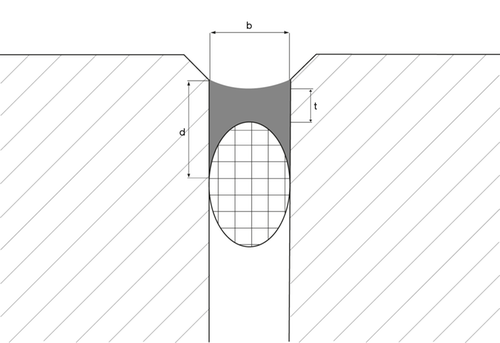
The rule of thumb for calculating the joint dimension is as follows:
Sealant depth (t) = 0.5 x joint width (b).
The thickness of the sealant (d) equals 2/3 of the joint width(b).
The ratio between the width of the sealant in the joint (b) and the depth of the sealant in the joint (t) has to be as follows:
| Joint width b in ratio of joint depth t (in mm) | Source: Industrieverband Dichtstoffe e.V. / HS PR. Additional information to the IVD‘s information leaflets under www.ivd-ev.de | |||||
| b | 10-15 | 15-20 | 20-25 | 25-30 | 30-35 | |
| t | 8±2 | 10±2 | 12±2 | 15±3 | 15±3 | |